
How To...
Don't know how to do it? Dr. Gourmet explains common cooking techniques and the hows and whys of what they are and why they work. More Cooking Techniques
Just Tell Me What to Eat!
The Delicious 6-Week Weight Loss Plan for the Real World
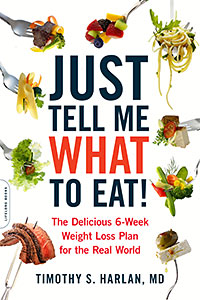
Timothy S. Harlan, MD, FACP has counseled thousands of his patients on healthy, sustainable weight loss. Now he's compiled his best tips and recipes into a six-week plan for you to learn how to eat great food that just happens to be great for you.
Get the prescription for better health as well as healthy weight loss, including:
- What to eat
- How to cook it
- When to eat it
- What to eat at a restaurant
- What to eat if you're in a hurry
- and best of all....
- Why eating great food is the best health decision you'll ever make.
Cooking Techniques
Thickening Agents
Cornstarch
Cornstarch is actually a flour. It is the endosperm of corn kernels that has been dried and ground, much the same way that wheat flour is made (in England cornstarch is actually called cornflour). Like other flours, cornstarch makes a good thickening agent.
It is frequently used in Asian cooking and a clear sheen is typical of sauces thickened with cornstarch. When used in baking, it helps produce a finer texture as well as a silky sheen.
There is, however, little similarity to wheat flour when using cornstarch to thicken sauces. There are a few rules for using cornstarch properly:
- It has twice the thickening power of wheat flour and it produces a clearer sauce.
- When starting with an acidic liquid (juices, vinegars, wines), the thickening power will be about half.
- It is best to mix it with water before incorporating it into a sauce, as it clumps easily.
- If the sauce is overheated or overstirred, it will begin to breakdown and lose thickening power.
Flour and Making a Roux
Used as a thickening agent for sauces, the traditional roux is equal amounts of flour and a fat (usually butter) cooked together. The length of time that the flour is cooked depends on the color of the sauce being made. Cooked for a short time, the roux has little color and is used for white sauces. As you cook it longer, the flour browns and results in a darker sauce.
There are many of my recipes that use flour to thicken sauces, but I don’t usually use equal amounts of flour and fat. Because there’s less fat you need to stir constantly while the roux is cooking so that the flour doesn’t clump. The reason for cutting back on the amount of oil is simple – to reduce fat and calories.
The ratio for a thin sauce is one tablespoon of flour per cup of liquid and two to three tablespoons per cup for a thicker sauce. If the sauce needs to be thicker I will often make a slurry to use as a thickening agent.
White Sauce
In French cooking a white sauce is called a béchamel sauce. It is traditionally made by heating an equal part of flour and butter (or another oil) whisking to keep the mixture smooth. This is known as a roux and the gentle cooking over a medium heat allows expansion of the proteins (glutens) in the flour. When a liquid is added the proteins bond to thicken the sauce. Cooking also helps remove some of the raw flour flavor.
If the liquid is milk or cream it is called a béchamel and using stock makes a velouté.
When trying to make healthier sauces the goal is to eliminate some of the calories and fat without affecting the flavor or texture of the sauce. Cutting the amount of butter or oil is the easiest way to cut calories.
With a roux the technique is to cook the flour in the fat before adding the liquid. When using less fat the flour has to be stirred constantly and will end up being drier than if equal amounts of fat and flour are used. Adding the liquid slowly and whisking constantly is the key to keeping the sauce smooth.
An easy technique is to cook vegetables in the oil. After they are softened dust the flour over them while stirring to blend the flour into the cooked vegetables. Done carefully and the flour won’t clump allowing you to use less fat and still end up with a thick sauce. Adding the liquid slowly is key.