
Mediterranean Diet Basics
The basics of the Mediterranean diet can be broken into 9 important areas of change for your health:
1. Vegetables -
This one's pretty easy. It’s hard to eat too
many vegetables...
2. Legumes - Making beans your choice for
a starch...
3. Fruits and nuts - Fruit is the perfect snack...
4. Cereals - Whole grains are really good for you...
5. Fish - More fish,
less meat...
6. Olive oil - This really means eating more
monounsaturated fat...
7. Dairy products - The traditional
Mediterranean diet doesn’t have
dairy products as a major focus...
8. Meats - Less meat and
lean meats...
9. Alcohol - There is good evidence that moderate
use of alcohol is good for you...
Need more information? Read about the research!
Just Tell Me What to Eat!
The Delicious 6-Week Weight Loss Plan for the Real World
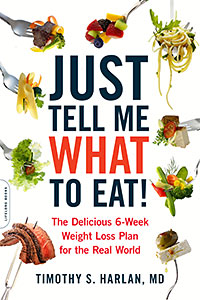
Timothy S. Harlan, MD, FACP has counseled thousands of his patients on healthy, sustainable weight loss. Now he's compiled his best tips and recipes into a six-week plan for you to learn how to eat great food that just happens to be great for you.
Get the prescription for better health as well as healthy weight loss, including:
What to eat
How to cook it
When to eat it
What to eat at a restaurant
What to eat if you're in a hurry
and best of all....
Why eating great food is the best health decision you'll ever make.
The Mediterranean Diet
(part 3)
There has been some concern that although a Mediterranean diet might be good for your heart, it appears to lead to weight gain and obesity. (And we know that being overweight is NOT good for your heart!) Specifically, surveys done in the European Union indicate that those who most closely adhere to a Mediterranean diet (the Greek population) have a high prevalence of overweight and obesity.
 A study published last year in the American Journal of Clinical Nutrition
seems to show that a Mediterranean diet does not, in and of itself, lead
to weight gain and obesity.
A study published last year in the American Journal of Clinical Nutrition
seems to show that a Mediterranean diet does not, in and of itself, lead
to weight gain and obesity.
The study included 23,597 male and female volunteers between the ages of 20 and 86 who were recruited to participate in a much larger European study to investigate cancer and nutrition. Subjects who had coronary artery disease, cancer, or diabetes were excluded.
For the study itself, each volunteer was weighed and their height measured so that their Body Mass Index (BMI) could be calculated. Their waist and hip circumferences were also measured and their Waist-to-Hip Ratio (WHR) was calculated. Finally, each volunteer answered a detailed food questionnaire regarding their dietary intake over the past year, which allowed the researchers to assign each volunteer's adherence to the Mediterranean diet on a scale of 0 to 9, with 9 being the highest level of adherence to the Mediterranean diet.
Researchers also collected information on the subjects' level of education, whether they smoked and if so, how much, their level of physical activity, and their average caloric intake, among others.
The results? The researchers found that:
BMI Increased: |
BMI Decreased: |
|
|
What they did NOT find, however, is any indication that a high level of adherence to the Mediterranean diet actually caused the subjects' BMI to increase. Even when the researchers did not take caloric intake levels into account, they found that a higher adherence to the Mediterranean diet only increased BMI by 0.21 among men and 0.05 among women. They found similar results for Waist-Hip Ratio, as well.
The high level of obesity in Greece? Most likely had more to do with low levels of exercise and overeating than with what type of diet people were following.
The take-home messages are twofold. First, no diet, even a heart-healthy style of eating like the Mediterranean diet, is a magic bullet. You can eat lots of food that is good for you and still risk your health by being overweight. Moderation in eating is key. Second, exercise is critical to low BMI and overall health. You can improve your health by improving your diet, but the only way to be slim AND healthy (because you can be slim and UNhealthy) is to eat right and exercise.
Research Articles - The Mediterranean Diet
The Mediterranean Diet and Genetics
We know that following the Mediterranean Diet can help reduce your risk of heart
disease, improve your cholesterol scores, and help you live longer, but what
we don't know is WHY that is. Research studies have suggested that the Mediterranean
Diet helps to reduce the systemic inflammation which has been identified as
a major risk of heart disease, but the results of those studies have been inconsistent
at best.
If You Needed Any More Evidence:
More on the Mediterranean Diet
Researchers in Italy recently pooled the results
of 12 previously-performed studies of the effects of the Mediterranean
Diet on people's overall health (BMJ 2008; 337:a1344). These studies
included, in total, over 1.5 million people and each study lasted between
three and 18 years.
The Mediterranean Diet and Death
in America
I've reported in the past on studies that investigate
the Mediterranean Diet's effects on cholesterol and heart disease. Recently
the National Cancer Institute, in partnership with AARP, published the
findings of a long term, large scale, prospective study (meaning the subjects
were followed through time) on the Mediterranean Diet and its effects
on all-cause mortality in the United States (Arch Intern Med 2007;
167(22) 2461-2468).
Mediterranean
Diet, lifestyle factors, and the elderly
Researchers in the Department of Dietetics
at Harokopio University, in Athens, Greece, evaluated the combined effects
of a Mediterranean Diet, alcohol consumption, physical activity, and other
factors on the cholesterol levels of persons 65 and over.
The Mediterranean Diet and
heart attack survival
We know
that the Mediterranean Diet can help prevent cardiovascular disease, but
what if you have an acute coronary event anyway?
Just a little olive oil
Olive oil has a well-deserved reputation
for helping to reduce the risk of heart disease.
Most of that reputation is from research into the Mediterranean Diet,
so named because it is a collection of dietary habits followed by those
in the region of the Mediterranean Sea.
More
interesting Mediterranean Diet research
Eating a Mediterranean diet
has clearly been shown to help reduce the risk of heart disease. Numerous
studies have been completed, but most have compared the diet to a typical
Western diet....
A
Mediterranean Diet Won't Make You Fat
You've probably heard that
a "Mediterranean Diet" will help
you live longer. . . . Recently, though, there's
been some concern that although a Mediterranean diet
might be good for your heart, it appears to lead
to weight gain and obesity.