
Great ingredients make for great meals. Whenever you can, use the highest quality supplies for your recipes. The flavor difference will always come through in your finished dish.
If there is an ingredient that you are not familiar with, check our Ingredient section. There are pages and pages of information about the ingredients used in my recipes.
Butter
Ingredient Information
Butter
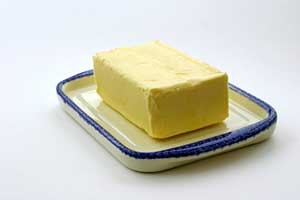
I get a lot of questions when I use butter in recipes. One of my friends wrote me with the claim that I use more butter since I have moved to New Orleans (not so). Others write in and want to know if it can really be used in healthy recipes. The answer is, of course! Fresh ingredients always have a place in great food. I use butter sparingly as a flavor enhancer and I do purchase the highest quality butter.
Butter is so wonderful. It is such a simple thing – fresh cream is churned, breaking up the fat globules that are normally suspended in water until the fat binds together trapping the water.
In the U.S. butter must contain at least 80% butter fat with the remainder made up of water and milk solids. The quality of butter is rated by the USDA based on flavor, aroma, quality of cream, texture and then given a "Grade Shield" – either AA, A or B. Quality butters start with the best cream and you should look for only Grade AA butter.
It used to be that there were only a few choices. Familiar butter like the venerable Land o' Lakes is certainly very good quality and is very consistent. There are, however, now a wide variety for you to choose from. In a lot of specialty markets (and even your grocery store) local dairies have carved out a niche for themselves supplying high quality butters. These are European style butters and have a higher percentage of butterfat -- at least 82% but they can be as high as 86% - 88%. This, combined with specialty cultures and churning methods, produces a smooth creamy, rich product.
This growth has been in response to a number of factors but the success of European quality butter such as Plugra a decade ago showed American dairies the way to the market. While I have found the flavor of European butters to be excellent in sauces, using them is not as critical in such recipes while using higher fat butters is more important in baking. The higher butterfat content makes for the best quality baked goods.
All of the recipes on the Dr. Gourmet website call for unsalted butter (if not, it's a typo: use unsalted butter). The amount of sodium in salted butter is minimal (a tablespoon has all of 115 mg of sodium). There is, however, a variation in the amount of salt added by different dairies, so using unsalted butter lends reliability to your recipes. This is especially true in baking where it is important to control the amount of salt, since subtle changes in ingredients can make a major difference in the final product. In short, I don't have any salted butter in my fridge.
Don't be afraid of butter. Like a lot of ingredients it's overused and if you keep the balance with the other ingredients in your recipes, it'll be just great.
1 tsp. unsalted butter = 36 calories, 4g fat, 2.5g sat fat, 1g mono fat, 0g protein, 0g carbohydrates, 0mg sodium, 11mg cholesterol