
The Health of It All....
These short tidbits of information can help answer questions on everything from Omega-3 Fats in fish to whether to cook chicken with the skin on or not. Want to know about garlic and cholesterol? Is it okay to eat eggs or not? It's all here.
The Health of It All
Butter vs. Margarine
 I've been involved in writing about nutrition now for over two decades, and
I have seen a lot of changes. I will see more
in the next 20 years to be sure. The one area, however, where I do believe
that we have a good understanding about what works and what doesn't is
fats.
I've been involved in writing about nutrition now for over two decades, and
I have seen a lot of changes. I will see more
in the next 20 years to be sure. The one area, however, where I do believe
that we have a good understanding about what works and what doesn't is
fats.
There's a long history, but suffice to say that it began with the mistaken assumption that all fats were bad, especially saturated fat. People were then told to follow a low fat diet. Not unsurprisingly, the average American translated this to mean that they should not eat any fat and to avoid red meat, butter and lard. During that time margarine was considered to be a "better" fat choice than butter.
The last 25 years of increasingly good dietary research has shown us that low fat diets are actually harmful and that it is the ratio of good quality mono and polyunsaturated fat to saturated fat that is key. We also learned that health problems have far more to do with trans-fats than saturated fats.
Basic, natural ingredients do contain trans-fats, but in small amounts. They are produced in high percentages when vegetable oils are hydrogenated: the process of making unsaturated fats more saturated to change their character and make them easier to use for baked goods and processed foods such as chips, cookies, cakes and other snack foods.
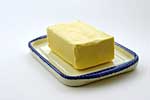
Butter, on the other hand, is the churned solids from cream, while margarine is made is from hydrogenated vegetable oil mixed with water. They have the same amount of fat per teaspoon, but butter usually has much more saturated fat, and because it is an animal product, it also contains cholesterol. Years ago it was the levels of saturated fat and cholesterol that damned butter, but it is now clear that the high levels of trans-fats in products like margarine and in the American diet has contributed far more to our health issues, including heart disease, than butter ever will.
In response our government mandated that trans-fats be eliminated from products sold and manufacturers have complied slowly but surely over the last 10 years. There is also the requirement that the amount of tans-fat be reported in the Nutrition Facts on all packages.
Stick margarine contains high levels of trans-fats. Food companies began producing "spreads" which are margarine-like products containing less fat, less saturated fat and only small amounts of trans-fats. As a result these products are not solid but soft.
The question is... what should you eat?
The answer is butter, but the spreads can be an OK choice every now and then. No matter what you choose, the key is to use these ingredients sparingly.
Keep unsalted butter on hand and freeze what you are not using. The butter that is kept in the refrigerator should be sealed in an airtight container to protect it from picking up other flavors in your ice box. When I use butter I measure it carefully, and for the most part I use it as a flavor enhancer. It takes very little good quality butter - about a teaspoon per serving - to make a sauce rich and silky.
There is a place for the spreads that are on the market. The two most popular brands are Promise Buttery Spread and Smart Balance. I don't cook with these very often - they can contribute to a sauce, but not in the same way as butter. A lot of people like to put margarine on their toast, and these spreads are a better choice, but there are so many great alternatives - jam, jellies, light cream cheese, cheeses and the like. The "light" versions are very low in calories at only about 50 per tablespoon.
Here are the numbers:
1 tsp. margarine = 34 calories, 3.7 grams fat, 0.78 grams saturated fat, 1.85 grams monounsaturated fat, 0 grams protein, 0 grams carbohydrates, 44 mg sodium, 0 mg cholesterol
1 Tablespoon (1 Tbsp = 3 tsp) Smart Balance Light spread = 47 calories, 1.4 grams saturated fat, 5.1 grams fat, 1.9 grams monounsaturated fat, 0 grams protein, 0.28 grams carbohydrate, 81 mg sodium, 0 mg cholesterol.
1 tsp. unsalted butter = 36 calories, 4 grams fat, 2.52 grams saturated fat, 1.17 grams monounsaturated fat, 0 grams protein, 0 grams carbohydrates, 0 mg sodium, 11 mg cholesterol.
For the most part I use butter, but as with all fats, I use it sparingly. Using great quality ingredients in measured amounts is the key. There are not really any "bad" ingredients. It is often that we simply use too much of a good thing.
Eat well, eat healthy, enjoy life!
Timothy S. Harlan, M.D.
Dr. Gourmet