
Get the Coumadin Cookbook!
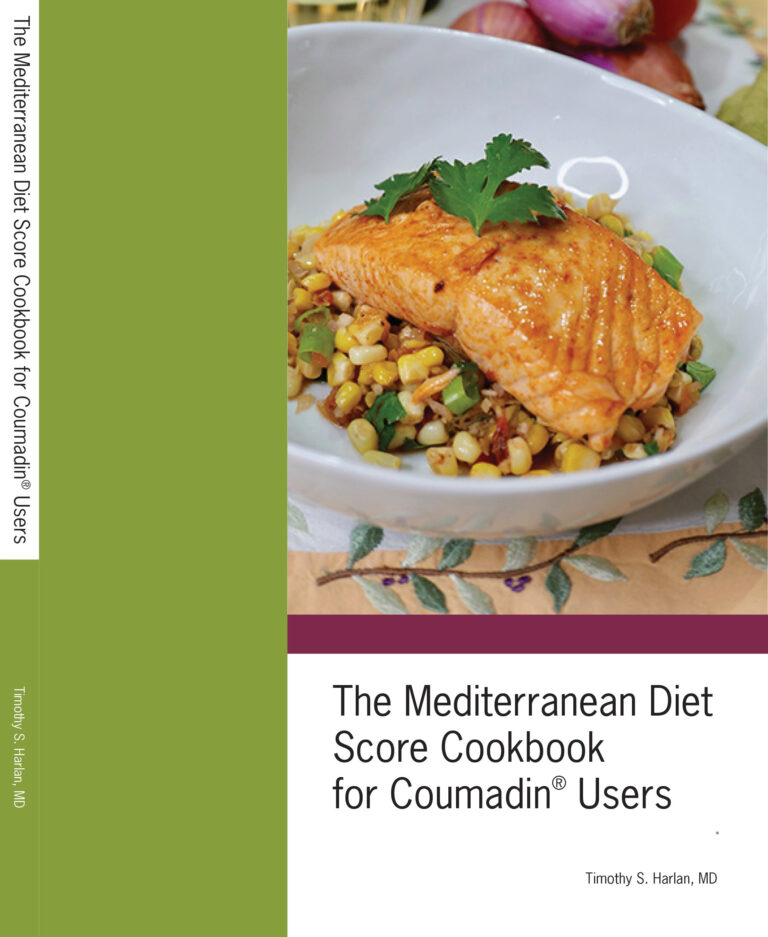
This indispensable book includes:
• A primer on WHAT a Mediterranean-style diet is and WHY it's great for you
• 95+ delicious Coumadin safe recipes
• Information about managing your diet on Coumadin
• Ingredient and cooking tips throughout the book
• Complete Nutrition Facts, including Vitamin K content, for each recipe
Buy the paperback | Buy the eBook (PDF document)
Questions about ordering? Click here to read the FAQ.
How to order by mail: We are happy to accept personal checks drawn on a US bank for delivery within the United States only. Download the form to order by mail. We regret that we are unable to process orders by phone or ship printed books outside the United States.
Note: This is a revised and updated version of Dr. Harlan's The Dr. Gourmet Diet for Coumadin Users. These are the same recipes with updated Nutrition Information, with the addition of information on a Mediterranean-style diet.
How Much Vitamin K is in...?
Find out the exact amount of Vitamin K (in micrograms) of almost a thousand common foods! Listed both alphabetically and then in order of the amount of Vitamin K in the food, this list will help you know exactly how much Vitamin K you're eating. Just $4.95 for the eBook (PDF) or $12.95 for the paperback. Get your copy now!
Read More Ask Dr. Gourmet Questions
Will non-alcoholic beer affect
your Coumadin dose?
Does grapefruit really interact
with medications? (See also....)
Are almonds a good snack
for those on Coumadin?
Is regular tea, iced or hot,
contraindicated while taking Coumadin?
I can't have broccoli or cauliflower because of its high Vitamin K levels
- why
is it in your recipes?
Does salt increase INR levels?
If I'm on Coumadin, can I use Green
Tea for weight loss?
Is Mona Vie (acai juice)
safe with Coumadin?
Can those on Coumadin (warfarin) eat eggs
or Eggbeaters?
Can I cook with parsley while
on Coumadin?
Are peanuts affecting my
Coumadin?
Should you avoid cranberry
juice on Coumadin (warfarin)? Updated
information!
Are there foods that interact
with Coumadin even though they are low in Vitamin K?
Does freezing "kill" the
Vitamin K in foods?
Can a person on Coumadin (warfarin) eat black
eyed peas?
Can foods low in Vitamin K still
affect my INR levels?
It's easy to get answers about health and nutrition! Just send your question by email to [email protected] and Dr. Harlan will respond to selected questions of general interest. Answers will be posted in the Ask Dr. Gourmet newsletter (sign up now!) and archived in the Ask Dr. Gourmet section of the website.
Please note that the Ask Dr. Gourmet feature is restricted to questions regarding food and nutrition. Due to the many questions we receive, not all questions may be answered. For more specific questions about your individual health, please contact your doctor. About Timothy S. Harlan, MD, FACP, CCMS | Terms of Use | Privacy Policy
Ask Dr. Gourmet
Does grapefruit really interact with medications?
Can you clear up a rumor/urban legend? The story is that people who take Lipitor must not eat grapefruit. Consequently, most seniors who live in Sun City, AZ do not eat this wonderful fruit that grows in their back yard. It is my belief that if you eat the grapefruit in the morning, and then take the Lipitor at night, there should be no conflict. What do you think?
Dr. Gourmet Says....
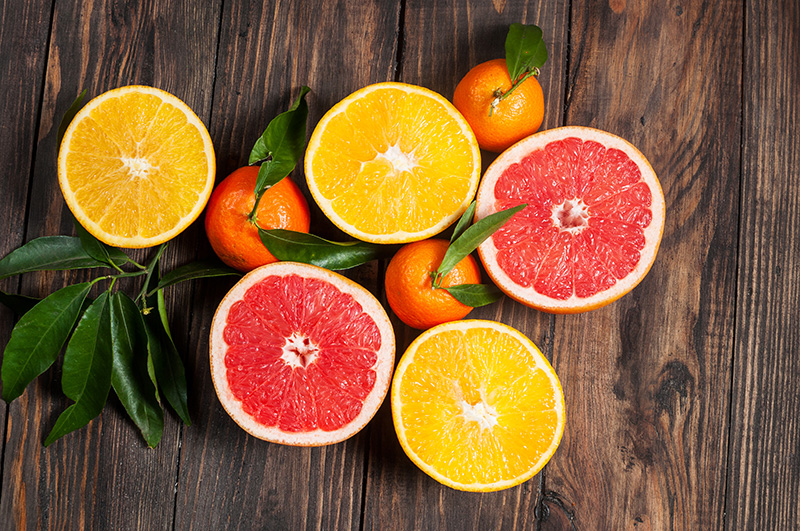
The interaction between grapefruit and some medications is not an urban myth. It is a fact.
This has been known for some time, but it wasn't until a few years ago that scientists identified the exact substance in grapefruit that causes the problem. We knew that furanocoumarins (a naturally-occurring substance found in grapefruit juice) had been found in laboratory tests to enhance the absorption of some medications, but lab tests are not the same as tests in human subjects.
A group of scientists created a furanocoumarin-free grapefruit juice to test against regular grapefruit juice and orange juice. Eighteen healthy subjects were recruited and given a medication that is known to be affected by grapefruit juice, along with a glass of either grapefruit juice, orange juice, or furanocoumarin-free grapefruit juice. Their blood was then drawn and analyzed for appropriate levels of the medication.
As they had suspected, it was indeed the grapefruit juice that contained furanocoumarin that had the most effect on medication levels. Sadly, furanocoumarin-free grapefruit juice is not available on the market, even though researchers noted that the furanocoumarin-free grapefruit juice tasted sweeter and less bitter than the regular grapefruit juice.
There's no research right now to confirm your theory that having the grapefruit in the morning and taking the medication later won't cause an interaction. While it is a good theory it's not proven and since these chemicals enhance absorption the grapefruit could very much change how much drug actually ends up in your body.
If you're on any medications, you need to be sure to tell your doctor what other medications or supplements you're using, as you can never be sure what might cause an interaction. Below is a partial list of the more common drugs that interact with grapefruit. The American Academy of Family Physicians has a fairly complete listing at https://www.aafp.org/afp/2000/0315/p1745.html, so if your medication is not on the list here on this page, check the AAFP's page to be sure.
Thanks for writing,
Timothy S. Harlan, MD, FACP, CCMS
Dr. Gourmet
PS: Here's more information about grapefruit and medications.
Medications that Interact with Coumadin (warfarin)
| Type of medication | Name (Brand name in parenthesis) |
| Anticoagulant | Warfarin (Coumadin) |
| Antibiotics | Clarithromycin (Biaxin) Erythromycin |
| Heart rhythm | Amiodarone (Cordarone) |
| High blood pressure (calcium channel blockers) |
Felodipine (Plendil) Nifedipine (Adalat, Procardia) Nimodipine (Nimotop) Nisoldipine (Sular) Verapamil (Isoptin, Verelan) |
| High blood pressure Congestive heart failure (CHF) (beta blockers) |
Carvedilol (Coreg) |
| Emphysema / Asthma | Theophylline (Theo-dur) |
| Cholesterol lowering agent (Statins) |
Atorvastatin (Lipitor) Lovastatin (Mevacor) Simvastatin (Zocor) Simvastatin-ezetimibe (Vytorin) |
| Immunosuppressants | Cyclosporine (Neoral, Sandimmune) Tacrolimus (Prograf) Sirolimus (Rapamune) |
| Anti-HIV | Saquinavir (Fortovase, Invirase) Indinavir (Crixivan) |
| Anti-seizure | Carbamazepine (Carbatrol, Tegretol) |
| Antidepressants | Buspirone (BuSpar) Clomipramine (Anafranil) Sertraline (Zoloft) |
| Anti-anxiety | Diazepam (Valium) Triazolam (Halcion) |
| Cough | Dextromethorphan (in many cough syrups and lozenges) |
| Pain | Methadone |
| Impotence | Sildenafil (Viagra) Tadalafil (Cialis) |