Get the Coumadin Cookbook!
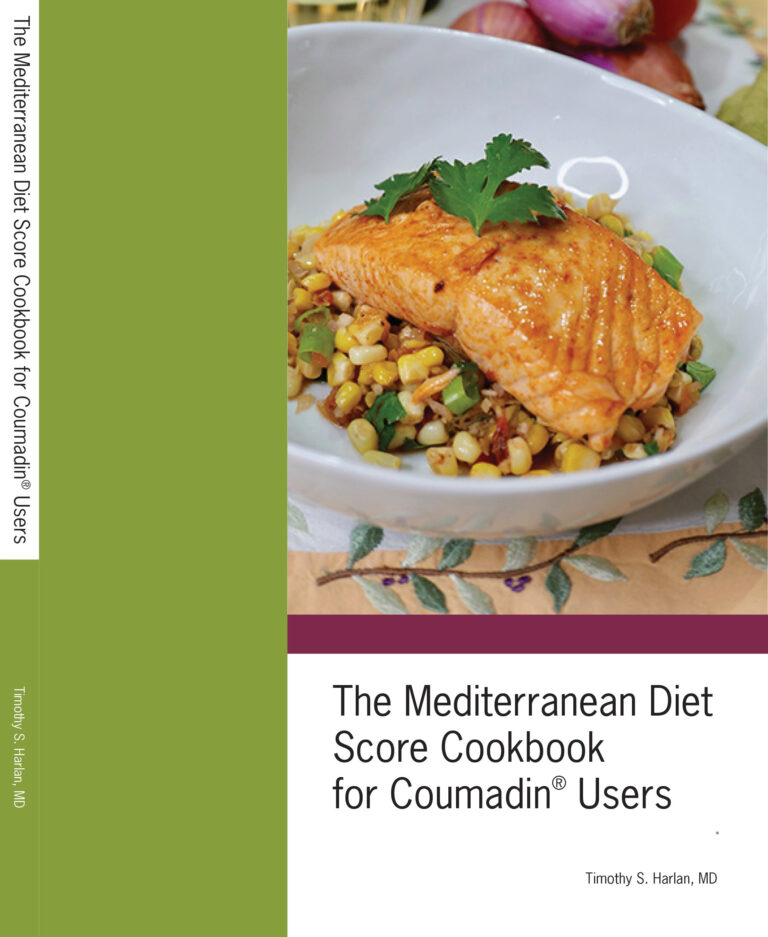
This indispensable book includes:
• A primer on WHAT a Mediterranean-style diet is and WHY it's great for you
• 95+ delicious Coumadin safe recipes
• Information about managing your diet on Coumadin
• Ingredient and cooking tips throughout the book
• Complete Nutrition Facts, including Vitamin K content, for each recipe
Buy the paperback | Buy the eBook (PDF document)
Questions about ordering? Click here to read the FAQ.
How to order by mail: We are happy to accept personal checks drawn on a US bank for delivery within the United States only. Download the form to order by mail. We regret that we are unable to process orders by phone or ship printed books outside the United States.
Note: This is a revised and updated version of Dr. Harlan's The Dr. Gourmet Diet for Coumadin Users. These are the same recipes with updated Nutrition Information, with the addition of information on a Mediterranean-style diet.
How Much Vitamin K is in...?
Find out the exact amount of Vitamin K (in micrograms) of almost a thousand common foods! Listed both alphabetically and then in order of the amount of Vitamin K in the food, this list will help you know exactly how much Vitamin K you're eating. Just $4.95 for the eBook (PDF) or $12.95 for the paperback. Get your copy now!
It's easy to get answers about health and nutrition! Just send your question by email to [email protected] and Dr. Harlan will respond to selected questions of general interest. Answers will be posted in the Ask Dr. Gourmet newsletter (sign up now!) and archived in the Ask Dr. Gourmet section of the website.
Please note that the Ask Dr. Gourmet feature is restricted to questions regarding food and nutrition. Due to the many questions we receive, not all questions may be answered. For more specific questions about your individual health, please contact your doctor. About Timothy S. Harlan, MD, FACP, CCMS | Terms of Use | Privacy Policy
Ask Dr. Gourmet
Are there foods that interact with Coumadin even though they are low in Vitamin K?
Love your website. It is so informative. On the paperwork from the pharmacy cranberries and cranberry juice are mentioned as foods to be avoided while on Coumadin. Is there a list of foods that may interact with Coumadin even though they are low in Vitamin K (i.e. peanuts and cranberries). Also, someone told me not to eat onions while on Coumadin because they act as a blood thinner. Finally, is soy protein isolate on the "no" list?
Dr. Gourmet Says...
Thanks for your nice words about the Dr. Gourmet website.
There is no list of ingredients that are low in Vitamin K that might have an effect on INR in those taking Coumadin® (warfarin). This is because most such information comes from isolated case reports.
The concern that some have with peanuts (which are actually very low in Vitamin K) is a compound called resveratrol. This is found in many plants including peanuts, grapes and berries like cranberries and blueberries. Resveratrol is an antioxidant and interest in it has been high because of the research showing that wine and grape juice might have a protective effect against atherosclerosis and heart disease.
There is research that shows this compound can have an effect on platelets (the blood cell that helps speed clotting). Partially inactivating platelets, resveratrol might be the mechanism that contributes to their beneficial effect. At the same time this might be a problem for users of Coumadin. There is, however, no evidence that I have found that peanuts affect INR levels.
There have been some case reports that cranberry juice can have an effect on INR levels. One report in the British Medical Journal in 2003 is concerning. The patient in question was drinking a great deal of cranberry juice and on an essentially liquid diet. There is a cautionary statement by the British Government about drinking cranberry juice while on Coumadin as a result of some other case reports. There have not been any such case reports that I have found in North America. (Updated information on cranberry juice - it's safe!)
Onions are low in Vitamin K and should be safe. Green onions (scallions, spring onions) are very high in Vitamin K and should be avoided, however.
Because mature soybeans are very high in Vitamin K many are concerned about soy protein powders and other isolates. There is a great deal of research going on about the benefits of supplementing with such preparations and none is conclusive. As one is not going to be able to determine the Vitamin K content of such soy products it is best to avoid them.
Thanks for writing,
Timothy S. Harlan, MD, FACP, CCMS
Dr. Gourmet
Read Related Questions
Is Lean Cuisine Coumadin
safe?
Does grapefruit really interact
with medications? (See also....)
Are almonds a good snack for
those on Coumadin?
Is regular tea, iced or hot, contraindicated
while taking Coumadin?
I can't have broccoli or cauliflower because of its high Vitamin K levels - why
is it in your recipes?
Does salt increase INR levels?
If I'm on Coumadin, can I use Green
Tea for weight loss?
Is Mona Vie (acai juice) safe
with Coumadin?
Can those on Coumadin (warfarin) eat eggs
or Eggbeaters?
Can I cook with parsley while
on Coumadin?
Are peanuts affecting my Coumadin?
Should you avoid cranberry
juice on Coumadin (warfarin)? Updated
information!