
Get the Coumadin Cookbook!
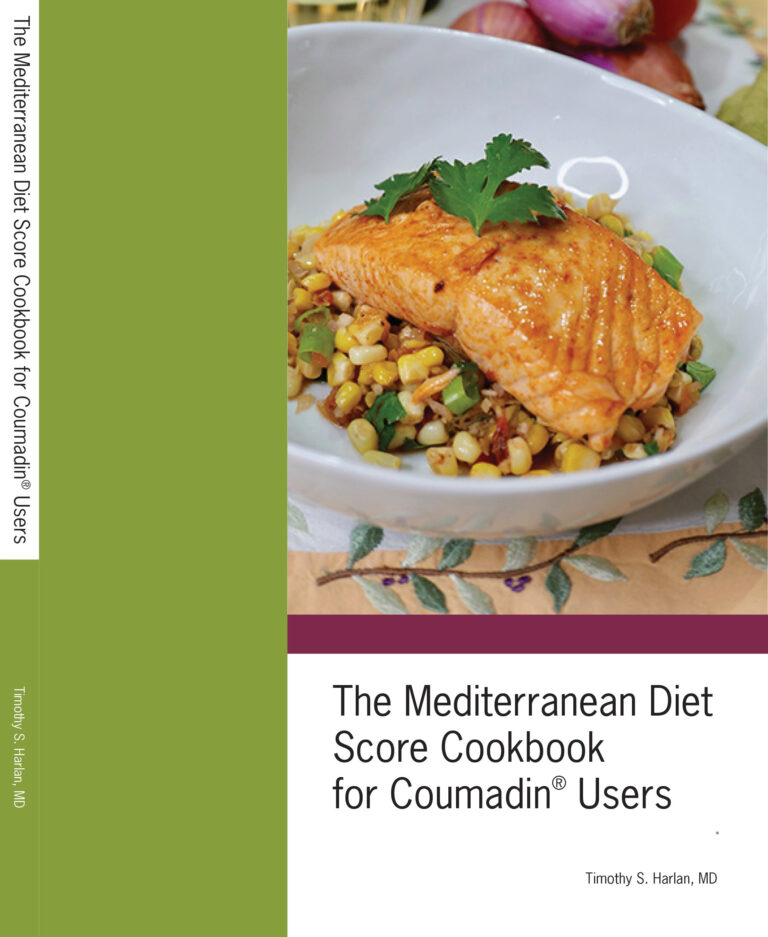
This indispensable book includes:
• A primer on WHAT a Mediterranean-style diet is and WHY it's great for you
• 95+ delicious Coumadin safe recipes
• Information about managing your diet on Coumadin
• Ingredient and cooking tips throughout the book
• Complete Nutrition Facts, including Vitamin K content, for each recipe
Buy the paperback | Buy the eBook (PDF document)
Questions about ordering? Click here to read the FAQ.
How to order by mail: We are happy to accept personal checks drawn on a US bank for delivery within the United States only. Download the form to order by mail. We regret that we are unable to process orders by phone or ship printed books outside the United States.
Note: This is a revised and updated version of Dr. Harlan's The Dr. Gourmet Diet for Coumadin Users. These are the same recipes with updated Nutrition Information, with the addition of information on a Mediterranean-style diet.
How Much Vitamin K is in...?
Find out the exact amount of Vitamin K (in micrograms) of almost a thousand common foods! Listed both alphabetically and then in order of the amount of Vitamin K in the food, this list will help you know exactly how much Vitamin K you're eating. Just $4.95 for the eBook (PDF) or $12.95 for the paperback. Get your copy now!
It's easy to get answers about health and nutrition! Just send your question by email to [email protected] and Dr. Harlan will respond to selected questions of general interest. Answers will be posted in the Ask Dr. Gourmet newsletter (sign up now!) and archived in the Ask Dr. Gourmet section of the website.
Please note that the Ask Dr. Gourmet feature is restricted to questions regarding food and nutrition. Due to the many questions we receive, not all questions may be answered. For more specific questions about your individual health, please contact your doctor. About Timothy S. Harlan, MD, FACP, CCMS | Terms of Use | Privacy Policy
Ask Dr. Gourmet
Is the Jenny Craig plan safe for those on Coumadin?
I have been on Coumadin since June 2005 for a second DVT. My INR for the last couple of months seemed to stabilize to 2.6 and 2.4 which is between my target rate of 2 & 3.
Last week I joined Jenny Craig's Diet Plan and learned that several of their products contain soy. Question: Is there significant danger in this?
Question: I'd like to know what daily content is considered a high dosage of vitamin K so that I can monitor my daily intake and develop a daily consistency rate. I learned that one of their products have 69 mg. of vit. K. The food item is a daily intake item which concerns me.
Question: Is there danger in eating iceberg lettuce and red cabbage for weekly salad intake?
Note: I was diagnosed with Multiple Sclerosis in May 2005 and have gained over 15 pounds since. I attribute the weight gain to the huge decrease in physical activity that I've been limited to and also to the medications that I am taking.
Dr. Gourmet Says...
I am not completely familiar with Jenny Craig products and the nutrition breakdown of their individual meals. I do feel that eating processed foods is not the best way to lose weight and be healthy for the long run. Often such programs with pre-prepared meals can help one get started, but most people cannot sustain eating on such programs for the long term. Working toward making your own fresh, healthy meals is a good goal.
The Recommended Daily Allowance (RDA) for Vitamin K is 80 micrograms (mcg) per day. By eating no more than this each day most people will have less risk of variations in their INR results. The Jenny Craig meals for the day at 69 mcg should be fine for you but if there is a wide variation between meals on a day to day basis, it could be a problem.
Many people can manage their intake by eating similar amounts of foods each day even if this means using ingredients that are higher in Vitamin K. This requires eating a salad each day, for instance, rather than only intermittently. For most who take Coumadin® (warfarin) this is more complicated plan than they wish to follow.
The easiest course is to eat only foods that are low in Vitamin K. This would mean using ingredients that contain less than 20 mcg of Vitamin K per serving and only occasionally using those with a medium amount (20 mcg to 40 mcg per serving). Here are three lists that vary from simple to comprehensive in their information about Vitamin K content.
Brief | En
Español : A short list of commonly-used
Medium | En
Español : A much longer list of foods, with their relative Vitamin
K levels (Low, Medium, High)
Extensive | En
Español : The same longer list as the Medium document, but with exact
levels of Vitamin K in mcgs.
By Micrograms | En
Español : The Extensive document but with the foods listed in
descending order by micrograms of Vitamin K.
These documents are in PDF Format.
Download
Adobe® Acrobat® Reader.
Having Multiple Sclerosis can be challenging given that it limits physical activity for many. Your working hard at changing the way you eat to compensate for this is commendable. Having patients like yourself in my practice is always rewarding. Keep up the good work.
Thanks for writing,
Timothy S. Harlan, MD, FACP, CCMS
Dr. Gourmet
Read Related Questions
I have burning mouth syndrome. Will Vitamin
B help?
If I'm on Coumadin, can I use Green
Tea for weight loss?
How many micrograms of Vitamin
K can I have in one day?
Are there supplements you can take to
help reduce your dose of Coumadin®?
Can you wean down your dose of
Coumadin®?
Does Coumadin cause fatigue?
How can I manage my Vitamin K intake on the Jenny
Craig diet plan?
Does Coumadin (warfarin) cause
weight gain?
Does Coumadin (warfarin) affect
your metabolism and cause weight gain?
Is there a low-sodium diet plan for
those on Coumadin?
Resources for renal/diabetic patients
on Coumadin?
My husband has gout, GERD, and is on Coumadin. What
can I cook for him?
Is this gum pain related to
taking Coumadin?